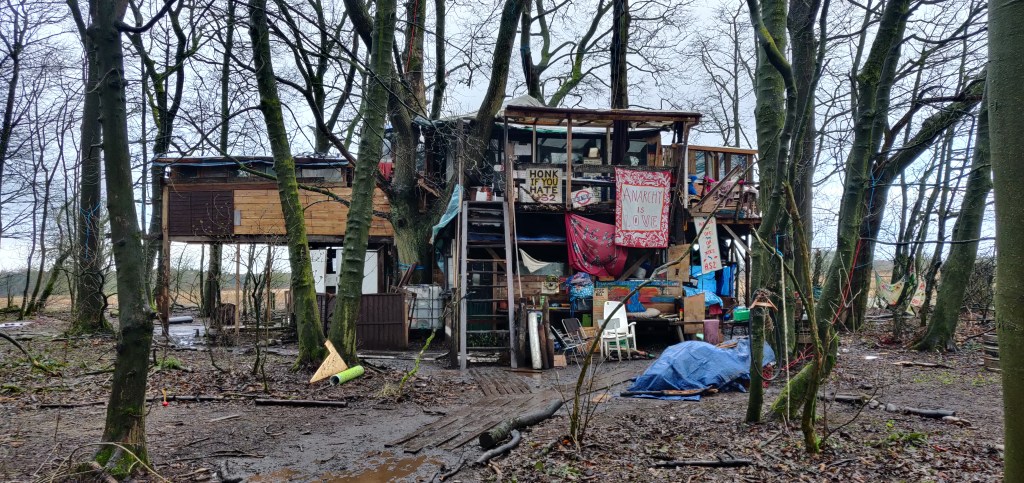

Discussion Between Guerrilla Nature (GN) and Activist Caren (AC)
Monday 17th April 2023
(GN) How are you?
(AC) I’m good.
(GN) I’m not sure how to introduce you… not sure… we should even give…?
(AC) Caren.
(GN) Yeah? Just Caren?
(dogs barking)
(AC) Mhmm.
(GN) Okay, cool.
(AC) Yeah.
(AC) (coughs)
(GN) And, er, how have the activism activities been going, of late?
(AC) Erm… So, this year, 2023, feels so far as if it’s been mainly about… facing the judiciary
(GN) Mhmm.
(AC) I mean, it started toward the back end of 2022 but 2022 was full-on, erm… kind of action-packed weeks and months, it seemed relentless, erm… and now this year, there’s a lot of focus on the fight that we’ve got going on with the judiciary.
(GN) Mmhm. As a result of the action taken in 2022?
(AC) Or 2021, for some of the Insulate Britain actions where we received a public nuisance charge, so erm, yeah, it’s just been a total ordeal… er, with the inconsistencies in the court system…
(GN) Mhmm.
(AC) So, these were the actions where we… caused disruption on the M25…
(GN) Right.
(AC) … because the government… wasn’t interested in meeting the demands from Insulate Britain, erm, which basically said to start insulating people’s homes, starting with the poorest people first…
(GN) Yeah.
(AC) …with the potential of creating 230,000 jobs, reducing our carbon emissions by 15% nationwide…
(GN) Just with one move?
(AC) …and obviously helping people financially, this was before the price rises and energy went up, so…
(GN) This is the thing with the activists, they kind of… the ones who do the research and are more at the forefront of pioneering the movement, they tend to see the patterns coming, don’t they? Before they happen, they see that the environment is linked to the economy and there are lots of interrelationships that people miss out on because they’re trying to separate issues.
(AC) Mhmm.
(GN) And you’re, ‘cause you were mentioning Insulate Britain, so you’re involved with Insulate Britain.
(AC) Yeah.
(GN) And, and… which other, which other organisations?
(AC) Er, so, Insulate Britain came, er, for me, came after, erm… Stop HS2,…
(GN) Mhmm.
(AC) … which obviously is a £200 billion fast and furious train, kind of designed in the twentieth century and being rolled out belatedly in Britain, erm… with a massive environmental impact and without, actually, any relevance to Jo Public, you know, this is going to be a very expensive train for high-fliers who just go from one city to another or another, it er… ordinary people won’t be using that train, even if they could afford it, because it doesn’t really go anywhere other than, you know, two or three major cities,…
(GN) Right.
(AC) …so that’s a pointless waste of taxpayers’ money, when they could be investing those billions and billions into public transport, locally, regionally and nationally, which could get us all out of our cars; woo, imagine that, imagine if we could stop our dependency on individual car use, you know, imagine the impact that would have on, er… carbon emissions, erm… on community, you know, we would start to come together and live together in communities more, if public transport was affordable, accessible, far-reaching, reliable…
(GN) Hmm.
(AC) …clean.
(GN) There seems to be a lack of vision, from what you’re saying, so what I’m hearing is… there was quite a, sort of, cogent suggestion of, “Well if we start with the poorest people and insulate our houses, then not only can we cut carbon emissions, but we can also help reduce the impact of what’s to come with the economic… “the impending economic situation,” let’s call it, which is always impending these days, isn’t it?
(AC) Hmm.
(GN) And then, with the train, same thing, the idea seems to be to… erm… support the upper echelons of society in progressing with their goals but leaving behind…
(AC) No consideration.
(GN) … those who don’t have and we miss, again, a thing that I want to keep mentioning, we miss that connection…
(AC) Hmm.
(GN) … between what’s going on economically and what’s going on ecologically and how there is a disconnection between those who are in power and those who are subject to their rule; and at the hardest end of that situation… So, you’ve been involved with Insulate Britain and the HS2 thing.
(AC) Yep, yep.
(GN) Did you get…? You, kind of, got in with the HS2, is that where it started for you?
(AC) So, XR came first, actually.
(GN) Okay.
(AC) Yeah, so XR was where it started, erm… my children, erm… for the most part of the time that I was parenting, which was about 25 years…
(GN) Mhmm.
(AC) Kind of, parenting with a dependant child at home still, was about 20-25 years… During that time, I wasn’t politically engaged with any, kind of, in any meaningful way…
(GN) Yeah.
(AC) … I was always interested ‘cause, as a young person I was interested and I was quite despairing as a 19,20,s21 year old, 24 year old… at what was going on around the world and I began to make sense of things, but felt totally disempowered as a young woman… what, the miners’ strike, supported the miners’ strike, ironically, to keep the coal mines open, erm…
(both laugh)
(AC) … but, you know, that was about, again, the powers that be prioritising profit over people, you know, …
(GN) Yeah.
(AC) … we’re still prioritising profit over people, profit over planet, it’s always profit that comes first…
(GN) And at the time, to be fair, although there were murmurings of potential for climate change and some of them have moved onto proper theories, there wasn’t as much focus on it as there is now, so…
(AC) Well, there was murmurings, nobody was murmuring about that in public…
(GN) No, yeah.
(AC) … You know, the, the… erm, tragedy for humanity, with regard to climate emergency is that people have known the horrors of where we’re going with climate breakdown for thirty years.
(GN) Wasn’t it 1970 something that, was it BP, or Shell? Shell, released a…
(AC) Oh, yes, actually, yeah, but in terms of the wide… the significant numbers of scientists and influential people… for thirty years, significant numbers have known about it…
(GN) Yeah, shouting.
(AC) Yeah.
(GN) Shouting. Not just about that…
(AC) No, no, no, they’ve not been shouting about it,
(GN) Okay.
(AC) They’ve known about it and they’ve deliberately kept it quiet. The information was out twenty years before that…
(GN) Yeah.
(AC) … but, people, it wasn’t becoming widely known amongst the people who had the most influence… but the, the… inexcusable truth is that many people in positions of power and influence – and they admit it themselves, most of them – are white, powerful men…
(GN) Mhm.
(AC) … They didn’t speak out about it because they didn’t want to “rock the boat”…
(GN) Mm, yeah.
(AC) And instead now, we’ve got a sinking boat, rather than one that was rocking and that we might have steadied up.
(GN) It’s interesting that you bring up the, you know, the sort of power – no, we’ve both brought this up – the power dynamics, but you’ve specifically mentioned, you know, that demographic that we all know is the sort of, the dominant one on the planet, or has been for a long time, which is the, you know, the upper class or middle class white male… and err… the, the economics of it all… I’m trying to remember why this… you said something a minute ago that inspired an idea… ah, that was it; so, nowadays, what I hear a lot of people say is, “Oh, this, er… green agenda, this is all the rich people trying to get us to do their bidding,” so it’s, it’s, again, it’s… I can’t prove to them that it’s not the case, when they’re saying, “Well why would we try to do these minor… things like recycle this and save this tiny bit of heating bill, when the companies who are chugging out all these CO2 fumes and sending stuff all across the world and destroying forests, they don’t, they don’t stop, they’re not subjected to these expectations, so why am I going to make my life difficult”… erm, and I try say to them that these companies are only making those profits because we are consuming what they provide, so if we reduce as much… if we reduce our consumption as much as possible then they have no reason, no justification for doing these things. But… it’s, it’s a difficult conversation to have because, like you, I recognise that… there is a connection and these people also recognise that there’s a connection, but we’re seeing it from… a, almost a completely different… a directly opposite angle.
(AC) That’s interesting, that’s interesting.
(GN) What would you say to them?
(AC) Well, what I would say is two things. One is that everybody needs to recognise the importance of the crises; you know, the climate and ecological crisis and the cost of living crisis. Everyone needs to recognise the… the existence, to start with; and everybody’s part to play.
(GN) Hmm.
(AC) Now, I think that’s a good starting point, because, if everybody recognises it and everybody says we’ve all got a part to play, that suggests that we’re all taking some kind of responsibility.
(GN) Hmm.
(AC) Now, I would agree with the ordinary person, if they were getting irate that they were walking their kids to school,… erm… taking holiday in Britain, by train…
(off camera voices not relevant to this discussion)
(AC) … stopping eating erm… meat and dairy, recycling, reusing, not buying new clothes,…
(GN) Mm.
(AC) You know, doing all of those really valuable things, of course they’re going to be annoyed if the government then continues to endorse new fossil fuel licences.
(GN) Mm.
(AC) You know, what’s the point of ordinary folk making an effort if the big boys don’t? So, totally agree with that… Erm… however, if ordinary people aren’t recognising the crises and wanting to take responsibility, you know, what hope’s the planet got?
(GN) Mm.
(AC) We need all the humans to be behaving responsibly, you know, I mean, for me the direct action is about turning the screw on the powerful people,…
(GN) Yeah.
(AC) … holding them to account and saying, “You guys, you know, we’re all doing this, that and the other, we maybe could do more but, hang on a minute, where’s the leadership?
(GN) Yeah, yeah, quite, well it, sorry to intervene… to, er… interject but the er… a, a very stark example of that, that… need not necessarily be related to the environment, or any issues that, you know that we’re talking about, is the covid thing, the double standards of the covid thing, if the, if it doesn’t… if the message doesn’t get home from all the other things, that is the starkest one, it just sits there, it’s a prime example of, “What’s good for the goose is not good for the gander.”
(AC) Yeah.
(GN) Sorry, I just wanted to point that out.
(AC) No, I am… I agree, 100 per cent and, you know, I was one of the people during covid who carried on more or less as normal except that I wasn’t living indoors, I was living outdoors fighting, erm, HS2 and, actually, the people who lived outdoors seemed to have more resilience than people who were forced to be cooped up, locked up, you know, estranged from their loved ones and, you know, becoming mentally and physically ill because they , you know, were stuck inside…
(GN) Mm.
(AC) …erm, stuck in buildings, you know. Meanwhile, if somebody wants to jump on a train and spread the disease around in the name of business, well that’s fine. And, of course, all the people who were privileged enough and entitled to have parties, well, that was fine as well.
(GN) Yeah.
(AC) So I would totally agree, but, you know, coming back to the point you made before about when people say, “Why should we do all of these things individually when the big work’s not happening at industrial level or government level, erm… I think blaming… is an unhelpful position…
(GN) Yeah, totally agree.
(AC) … because, if there’s one time in the planet’s history, or in the history of humanity when we need to recognise that we’re all in this together, it’s now. And what actually often happens is that, erm, left wing will blame the right wing, er… young people will blame old people… old people, somehow, manage to blame young people, I don’t know… I can’t believe the number of old people who say, “Well, it’s the young people’s future, why aren’t they trying to do something about it?!” And I’m thinking, “Did I really hear that?” You know, but anyway, that happens, erm, and then you get… erm, disempowered people blaming empowered people, you get empowered people in Britain blaming China, you get ordinary people in Britain blaming China and India…
(GN) And asylum seekers, yeah, or…
(AC) …it’s always somebody else…
(GN) … benefit scroungers…
(AC) … you know…
(GN) … Yeah, yeah.
(AC) … and that blame, it… that’s just to avoid facing… the horror…
(GN) Mmm.
(AC) … and taking some kind of responsibility… it’s… that’s what the blaming is about, just to avoid that position, which is a position that, if we could all shift to, you know, recognising the problem and stepping into a responsible place and looking to work together, we might get somewhere.
(GN) We’ve got a chance. We’ve got a better chance than we have now. There’s an organisation called New World Together, set up in Bali, have you heard of them?
(AC) I haven’t, no.
(GN) Benjamin Cast… I want to say his name correctly, I don’t remember him saying it, I think it’s Casteillo. I hope I said that correctly, but Benjamin, top, top man, love the guy… Er… and he set up New World Together as a Non-Governmental Organisation that is, its aim is to… is to open up the conversation about things that we find so uncomfortable, about the damage that we’re doing to ourselves; about what is often termed a collective neurosis or psychosis, and erm… yeah, the conversations I had with him were similar to the content you’ve just… you know, the idea we’ve just been discussing, or the concept that we are discussing, which is, the way I interpret it is this differentiation, this distinction between blame and responsibility, or, or… shame and acknowledgement, you know, we’re… we seem to be so stuck in this combative, confrontational, it’s one or the other…
(AC) (coughs)
(GN) … kind of way of seeing things, framing things that we restrict our ability to be honest in conversations, because people are scared of getting blamed, rather than being prepared to take responsibility, or scared of getting shamed rather than being prepared to acknowledge what action has been taken and what effects that has had, because if you’re going to get blamed for it and you’re going to get shamed for it when you get blamed, there’s a chance you might want to shift that blame onto someone else; whereas, if you’re all going to take responsibility, then… Grenfell, for example; okay, so, somebody put – somebody made those tiles, not fit for purpose, somebody put them on the building, somebody authorised that, somebody else seconded it, somebody wrote the budget; you know, there is all those participants and it seems like the idea was to try and blame one person and, as far as I’m aware, nobody ever took any responsibility. Now, instead, if they collectively take responsibility…
(AC) Yeah.
(GN) … then, maybe, everybody doesn’t have to go to jail for a long time,…
(AC) Yep.
(GN) … maybe people can learn some lessons and pay some money into soe funds to say sorry, not that that’s good enough, but, you know…
(AC) Collective responsibility.
(GN) … we can publicly acknowledge, “We did this thing, it had this effect, we’re not right or wrong, but we know now that if we hadn’t done it, those people wouldn’t have died, so we are sorry that we did that, you know…
(AC) And…
(GN) … but, sorry I keep analogising, but I feel like, a lot of the time, the environment… environmental issues kind of fall on deaf ears a bit, so I feel like, occasionally, if we relate it to other injustices…
(AC) Mhmm, yeah.
(GN) … then we can start to see the pattern a little bit.
(AC) No, absolutely, because, the other thing about, you know, your suggestion there, as to how that collective responsibility might have manifested itself… erm… that to me sounds like… not only the least that could be done, in terms of acknowledging the wrongs and the tragedy… erm, tragedy doesn’t seem to be, erm, a strong enough word…
(GN) It’s not adequate, is it?
(AC) No, it isn’t.
(GN) It’s definitely a… a travesty.
(AC) Yeah.
(GN) An injustice.
(AC) Yeah.
(GN) I think we could use a lot of adjectives but none of them would suffice.
(AC) Yeah…erm… but… the point that you were making reminds me of the approach which is recommended across lots of movements these days. It’s about… people’s assemblies, citizens assemblies, it’s about the working together, it’s about people sitting down as groups and saying, “This is wrong. What can we do to make things better?” And even though it’s a different situation, the attitude… is similar, in terms of: people own, share, look at solutions to move forward to a better place and we just don’t have a society that operates like that at the moment.
(GN) No, no.
(AC) And, erm, and this is one of the big challenges, er, is lots of people in lots of communities who are organising and existing, erm, in a very alternative way, more along those lines, erm, but in terms of large scale alternative governance, we’re miles away from it, erm, unfortunately.
(GN) So, you mentioned people’s assemblies and I wonder, if anyone, if anyone ever does watch this, er… you know, what would you like to help… what would you like to tell people about people’s assemblies. What’s the idea behind them, how can people organise them and get involved, and who do they contact if they want to…
(AC) Yeah.
(GN) … be involved in what’s already going on or get advice about how to set something up of their own accord?
(AC) Yeah, so people’s assemblies, I think this is right, er, well, I might be wrong and I’m very happy for someone to correct me at some point… erm…
(GN) See, that’s important, isn’t it? Sorry, just, incidentally, that is exactly what we need; when somebody says something, “I’m saying this, as far as I know this is correct, but…”
(AC) Ha, yeah, yeah
(GN) “… if it’s not correct, please help me to learn, yeah?”
(AC) Yeah, yeah.
(GN) And if we could all do that, we could get on a lot better with what we have to do.
(AC) It’s a little bit more… er… leaving the door open so that we can bring in the improvements, but Jeremy Corbyn’s peace and justice movement…
(GN) Hmm.
(AC) … I think they were the drivers for people’s assemblies.
(GN) Right.
(AC) Erm… Now I know that Extinction Rebellion, erm… have been, erm… promoting citizens’ assemblies and citizens’ assemblies, erm… are like people’s assemblies but on a bigger scale, where… where a local authority would, kind of, select people, erm… from across society… to represent the community, rather than be voted in… erm… like we have the local councils. So, citizen’s assemblies would involve… I mean, it’s, certainly, I think it’s quite open to corruption as well you know…
(GN) Hmm.
(AC) … because they say, “Oh, er, we’d have “specialists in this,” and the minute anyone uses the word specialist, I go, “O, ooh, feeling nervous,” you know…
(GN) Yeah.
(AC) … because people who… see themselves as specialists, erm… if we’re not careful, they’ll end up being from the same bag as the people who are powerful and, er… I don’t know… don’t know quite where I’m going with this but…
(GN) I get you. There’s a man who I know who makes a lot – talks a lot of sense.
(AC) Yeah.
(GN) His name’s Lee and he once told me, “Smart people listen to smart people,” and then we added to that, “But the really smart people know who to listen to – the real smart people know who the smart people are listening to, do you know what I mean? So it’s… we do need in society people who know a specific area of study…
(AC) Hmm.
(GN) … or know about a subject, we need that…
(AC) Hmm.
(GN) … but there is a level of apprehension when somebody’s given this… this, erm… sort of, irreproachable status, like, “Ooh, they’re a doctor, they can’t be wrong.” Well, doctors disagree with each other all the time…
(AC) Yeah, or solicitors, legal people…
(GN) … or scientists, yeah, yeah!
(AC) … yeah, people just eating out of their hands and there’s not enough challenge and scrutiny (coughs), you know, but…
(greetings being offered off camera)
(AC) … Hi (responding to off camera greetings), hi… (back to discussion) … erm, people’s assemblies… is erm… it’s something different altogether, it doesn’t involve, kind of, selection and representation, it’s just about people on the street, let’s say, coming together, let’s say people on the street said, “Right, the government’s not going to insulate our homes, so we need to insulate our homes…”
(GN) Mmm.
(AC) “…let’s all gather together on the green and have a people’s assembly about how we can fix our homes for ourselves.”
(GN) So people’s assemblies, sorry, maybe I didn’t distinguish between these two before then, apologies if I didn’t. And maybe you said people’s assemblies and I said citizens’ assemblies…
(AC) No, I brought in citizens’ assemblies.
(GN) Oh, okay, so that’s, that’s a really important distinction to make though, isn’t it, is…
(AC) (coughs)
(GN) … people’s assembly is something that can just be set up by anyone anywhere, effectively, just erm…
(AC) Self-organising.
(GN) Yeah, there’s a… I’m trying to remember the name of the organisation, it’s named after a man… he was the father of the woman who runs it now, I think…their… the phrase they teach people is “solidarity” and they’re… they’re on Instagram as “Solidaritea” with T-E-A… “tea” spelt as T-E-A. and I think that’s the same organisation, but again, might be incorrect there, so apologies if that’s… but they’re definitely connected somehow… and er… yeah, it’s that idea, that idea of solidarity is something that people miss out on.
(AC) Mmm.
(GN) And the people’s assembly sounds like the perfect…
(AC) Bringing together.
(GN) …Embodiment of that…
(AC) Yeah.
(GN) Yeah, yeah, self-organised, like you say…
(AC) Pool your skills…
(GN) Yeah.
(AC) Pool your ideas. Pool your time…
(GN) Yeah, yeah.
(AC) Pool your resources…
(GN) See, time, that big T word, that’s the one that gets people though, isn’t it?
(AC) Mmm.
(GN) You know, you have a… the amount of times I’ve got a message and gone, “Ah, if I… if I was not in the middle of this thing that I’m in the middle of, I would go and do that, but…”
(AC) Hmm.
(GN) And then it… also, other people message you and say, “We’re having this thing at this time,” but then… sometimes it doesn’t happen on time… er, yeah, organising things with people could be tricky, which is why people get so demotivated so quickly isn’t it, I think.
(AC) Mhmm.
(GN) But, unless we do it, no-one’s going to do it for us. So, the citizens’ assembly, that’s… that’s like an official version of the people’s assembly that’s…
(AC) I think so, yeah.
(GN) Yeah, okay, under local council, but I’ve seen there was an experiment with that. Didn’t they do something similar…?
(AC) In Ireland, didn’t they?
(GN) Okay, is that where it was, yeah?
(AC) Yeah.
(GN) Okay.
(AC) Yeah, I think g they had a successful example of it, In Ireland. And erm… I think there have been a couple… erm… in other parts.
(GN) Hmm.
(AC) Erm… so… yes, yes, it’s definitely a model, I don’t think it’s been adopted as quickly as it could be, I mean, right now, we’ve got the local elections coming up in May…
(GN) Hmm.
(AC) … Er, we’ve got… a tory party that hasn’t managed to get anything right for months and months and months. And yet, some people seem to think that they might vote tory.
(GN) What, at the general election? Or the local?
(AC) Yeah, well, just I terms of the local elections will be a big indicator, now, the Labour Party is in meltdown…
(GN) Mhmm.
(AC) Erm… there’s been a purge going on, you know, erm… Kier Starmer is now being revealed to be… quite a scary, erm…
(GN) Prospect.
(AC) … Prospect, yes. And not a left wing prospect. Erm, you know…
(GN) That’s… I’m very confused about how people interpret his… ‘cause, I was told by a friend of mine whose very much into… er… socialist politics, let’s say, that’s his angle, I don’t know if he’d call himself left wing because this left/right thing is very…
(AC) Nebulous, at the moment.
(GN) … yeah, and it’s so, it’s so, erm… misguiding, it’s, it’s… it’s not really how it works.
(AC) No.
(GN) Tommy Shelby in er, what’s that, what’s that programme? Peaky Blinders.
(AC) Yeah, yeah.
(GN) He said if you go far enough one way, you end up on the other side…
(AC) Yeah.
(GN) … and that was a really good point, but a friend of mine, he said about the Labour leader… he who shall not be named…
(AC) Yeah.
(both laugh)
(AC) It’s hard to put those two words together, really;…
(GN) Yeah…
(AC) … his name and Labour leader…
(GN) … and Labour leader, yeah, it doesn’t seem… I was never comfortable with it but I‘m not as staunch a supporter of the Labour Party; in fact, I … I support the Green Party ahead of any other, to be honest, but he’s always been very much into supporting Labour and he was going, “Oh yeah,” I mean, he was advocating for this guy, saying, “Oh, he’s a… he was a human rights lawyer, he’s, like, he’s red to the core, he’s this and he’s that and I was like, he doesn’t…
(AC) He is the one…
(GN) … he doesn’t come across to me like that, I don’t know.
(AC) … Julian Assange has been locked up under Kier Starmer… you know, Kier Starmer was the head of the Crown Prosecution, wasn’t he?
(GN) Right, okay.
(AC) He had a massively significant role in the judiciary.
(GN) Right.
(AC) Erm, and yeah… so, and, erm, in terms of, erm… the… criminal justice bill… 1994…? Oh, I can’t remember, but anyway, there’s been a steady erosion of our rights…
(GN) Right.
(AC) … and Kier Starmer has had a significant part to play in that, erm, as well as in, you know…
(GN) Yeah.
(AC) … incarcerating political prisoners…
(GN) Who have done little other than try and open up the doors for freedom of speech and…
(AC) Yeah.
(GN) … information.
(AC) Yeah, and in terms of his purging of the socialists within the Labour movement, erm, it’s utterly inexcusable, I mean, I don’t know how anybody can think that Labour at the moment would represent… the least empowered… I mean, I, I… I don’t know about using the term “workers” anymore because to me, that, I, that’s a word that I would have associated in the past with… kind of, you know, Britain coming through the, kind of, 1900’s when there was a huge work force and…
(GN) Hmm.
(AC) … you know, most of them didn’t have the vote and there was, you know, a lot of profit being made, and no rights and that… that’s for me, that kind of notion of workers… erm… I associate with that, erm… you know, there’s a lot of workers who vote tory these days.
(GN) Hmm.
(AC) There’s a lot of workers. What’s work? You know, if you’re doing, you know, if you’re working in a factory on a, on a… production line and you’re getting paid, er, £15 an hour…
(GN) You would be lucky! (laughs)
(AC) … or if you’re a teaching assistant in a school, getting paid £9 an hour, you know, erm… are they all “workers”?
(GN) Hmm.
(AC) You know, so yes they are, but the other thing is, is that “workers”, erm, traditionally, did vote left wing, they were represented by the Labour Party; whereas now, you’ve got no, you know, people… there’s lots of those people, those “workers” who are voting tory because…
(GN) Most of the, most of the… most of the least empowered are aspirational, aren’t they? They aspire to be… or at least a huge enough er, proportion of them for it to have a significant impact, they aspire to be more empowered through financial success, through gain.
(AC) Mhmm.
(GN) And therefore, it feels… it feels to me like crabs in a barrel…
(AC) Mmm.
(GN) … and er, you know, they’re going to vote for the guy who they think is going to help pull them up out of the barrel, you know?
(AC) Yep.
(GN) And it’s… it’s a sad misunderstanding, or misrepresentation, or misinterpretation of how things really work.
(AC) And I also think that the way our society has changed makes it very difficult for people with no money to organise other people with no money…
(GN) Mmm.
(AC) … and represent each other, you know, it’s very easy – and we’ve seen this in Leicestershire – seeing, you know, right wing politicians shipped in form down south into a likely-looking constituency where they’ve started to… they’ve taken the party money… and they’ve gone and they’ve met a business person who wasn’t necessarily very political but now, he’s become their friend and, you know, they wheedle away and over the months and over the years, you can create a new network of people who would never have naturally become “blue”…
(GN) Mmm.
(AC) … if they’d have been wooed and seduced by the left wing, you know. And… but because…
(GN) Money talks.
(AC) …money talks… and there’s, you know, since Thatcher, there is no such thing as community – was that her phrase? But communities…
(GN) “Society,” wasn’t it, I think she said…
(AC) Was it?
(GN) “No such thing as society.”
(AC) Well, society, community, well there isn’t actually much sign of that anymore.
(GN) I’m not correcting you when I say that, I might be incorrect about that.
(AC) But it’s the same notion, it was all about the individual, she was all about the individual.
(GN) Yeah.
(AC) And, what I’m trying to say is that, erm… in a society where we’re all separated off in units and we’re being… we’ve all got tellies and we’ve got phones and all the adverts are telling us how we want to be and what we want to buy next, actually, the values, which in the past, you know the socialist values, distribution of the wealth, the ensure that we’ve got services that meet the needs of the vast majority of society, you know, erm… you’re not going to get those messages through if there’s not a meeting place.
(GN) Mmm.
(AC) And there used to be meeting places in the past for those people because we weren’t all isolated in our homes.
(GN) Mmm.
(AC) It’s much easier for the right wing, with their money, to mobilise and to change people’s views than it is for… the left wing, which generally has less money.
(GN) Hmm, yeah. And that, that is the biggest… well, I mean, I don’t like to use left and right but there is, there is clearly a… a… bunch of people who have an awful lot of money, who have much more influence than those who don’t, that’s definitely, definitely… something I can say for sure.
(AC) Hmm.
(GN) Yeah, and some people would say, well that’s just the way it is and I would suggest to them that it’s only the way it is if we continue to perpetuate our situation and it’s upon… it is, it’s funny because we’ve mentioned the individuals, we’ve mentioned the not having meeting places, but the, the er, the other side of that is, the individuals make up the collective and, instead of meeting places, we now have connections to each other digitally, which, a lot of the time are impeded by, er… you know… policies on some sites… again, reference Covid and things – videos being shut down, which actually turned out to contain a lot of truth…
(AC) Hmm.
(GN) … and that sort of thing. So there is suppression of truth online, er, but… just as much as back in the day you’d have propaganda in newspapers, persuading the local people before they went to the pub or the town hall or wherever and, you know, The Ragged Trousered Philanthropist is a good story to learn about this sort of idea, this idea that it’s through friends and connections and expectations that things are achieved but that quite often means the oppression of the less empowered. But we don’t need to keep doing that now, we have the opportunity to open ourselves up…
(AC) Hmm.
(GN) … to the information that will enlighten us, but it feels… like, NWT – New World Together – would say that one of the biggest problems we have is that people don’t want to look at the truth.
(AC) Yeah.
(GN) They don’t want to acknowledge it.
(AC) Yeah, well, I mean, people often say – and this is something that has often been said – is that things have got to get worse before they get better and, to be fair, now that the cost of living crisis is hitting so many people, you know, there’s been a shameful number of disempowered and impoverished and homeless and… erm… ill, unhealthy people, erm… at the bottom of British society for years and years.
(GN) Hmm.
(AC) But the majority have been doing all right, Jack.
(GN) Hmm.
(AC) And so, there’s not been enough interest by the majority to ensure that those at the far end of poverty in our society were cared about, you know, and, and… some people will say that the increase in the energy prices and the cost of living means that they don’t have the same kind of disposable income anymore, you know, they can’t pay… erm, their bills, never mind their Netflix subscription or their… take away on a Friday…
(GN) Hmm.
(AC) … bill. You know. And when those kind of… erm… luxuries and comforts are removed, that’s when people start talking and that’s where we’re at now.
(GN) Hmm.
(AC) Actually, it’s far worse than that, because the bills have gone up so radically… you know, that it’s hit people’s day to day lives… massively more significantly than being not able to afford the monthly…
(GN) Netflix
(AC) … Netflix subscription…
(GN) Yeah, yeah.
(AC) … or a Friday night, erm… chip shop visit.
(GN) Hmm.
(AC) You know, it’s far more serious than that and it’s come with an absolute blow, but maybe that it is what is going to get people to start, kind of, coming off the social media. And you know, I think social media – I mean, there’s some dreadful things around social media but there’s also, erm… some things – you can reach people but, I have to say, there’s not much point reaching people if all you ever do is sit inside reaching people.
(GN) Yeah.
(AC) If you don’t translate that connection to something out on the streets and, you know, going to the places where the power actually lies and the money is actually spent and the policies are actually made… but then, most people in Britain aren’t interested in that.
(GN) Mmm.
(AC) They say, “Politics is boring.”
(GN) Mhmm.
(AC) You know, you hear that a lot… British people, they’re above politics, you know, and, and… this is the price we pay; they’re above being interested in politics and, you know, it’s erm… but actually, you know, people are now beginning to realise that politics is an every day thing that affects us all.
(GN) Yeah, it’s party politics that… we… there seems to be a failure to distinguish between party politics and politics.
(phone ringing)
(GN) I’ll er, I’ll wait… do you want to answer that?
(AC) (shakes head)
(GN) No? So, I say this to people quite often: “You’re talking about… politics is any group make… group decision making,” so…
(AC) (coughs)
(GN) … that necessarily involves politics, if you’re making a decision and you’re involving the opinions of more than one person, you are into politics, one way or the other, because you have to take account of two different people’s ways of seeing things.
(AC) Hmm.
(GN) And what’s politics, apart from making decisions that affect a group? That’s what politics is, right?
(AC) Mhmm.
(GN) So… this failure to distinguish and, to me, this… this, kind of relates very strongly to something you know I’m particularly interested in, which is the way we communicate; the way we use language. And they way we use language seems to have become so… erm… ah, people seem to think they’re above that.
(AC) Hmm.
(GN) They seem to think, “Well, I don’t need to learn English, everyone uses English the way they use English and it doesn’t matter if what I say doesn’t make sense to someone else, ‘cause I know what I meant.”
(AC) Hmm.
(GN) And you think, well, yeah, okay, to an extent, you know, you have colloquialisms and if I use the word mardy and someone from London doesn’t know what I mean, then I might need to explain it to them, maybe, but generally, if you structure a sentence in a reasonable way, I can understand what it means and, we can, you know, have a conversation, but people seem reluctant even to do that. And, er, yeah, I don’t want to get too much on the language thing ‘casue I know that’s just my little bugbear.
(AC) Mhmm.
(GN) But, erm… trying to go back on what you were saying just now…
(AC) About party politics… about party politics and… yeah… politics…
(GN) … being above it…
(AC) …Yeah
(GN) … being above it, yeah. And… It’s funny because most people don’t, I mean, I don’t… I don’t comprehend most of government policy and why, I don’t… the decisions they make don’t make sense to me…
(AC) Mhmm.
(GN) … but when I try and discuss it with people, they quickly lose interest…
(AC) Well…
(GN) … so how are we to make sense of things?
(AC) … well, I mean, system change, I mean, I taught, I taught in schools for a number of years and, you know, I was required to dish out… a crap curriculum, right?
(GN) Mmm.
(AC) Now, I’m not saying that running an education system is easy, but, erm… societies need to recognise when we’re doing everyone a disfavour, you know; the children, the families, who have to live through all the stress of, you know, getting their children through exams and ticking all the boxes and putting up with hostile environments in school… erm… sometimes. And then, of course, being a teacher; I wouldn’t wish it on anyone, you know.
(GN) No.
(AC) I wouldn’t wish it on anyone, I left because I thought, I’m going to die with exhaustion and depression, erm, because I’m just… running to stand still… and no one in the school was enjoying what they did.
(GN) Yeah.
(AC) Why, why should – why is there a load of people going there every day to an environment that is full of stress and…
(GN) Toxic.
(AC) … it is, toxic. And not every school is like that but I do think the majority of them and… have, have… ended up in a desperate place and there’s just not enough time and energy and money and investment and consideration and love and… and, and erm, and…
(GN) It’s the same, it’s the same story…
(AC) … it’s the same with everything, yeah…
(GN) … unfortunately… and this is, this is why it’s so important, I mean, we’re just sitting here now, talking, and I’m – and the idea with this is that hopefully we share this conversation and some people feel compelled by what they hear to somehow get involved – but I know, you know, I haven’t contributed physically as much as I would like to and I know that…
(speaking off-camera)
(GN) … we’ve got the rebellion coming up in April, so maybe we…
(AC) Friday.
(GN) …it would be a good idea to discuss that…
(AC) Yeah.
(GN) … and, erm… you were out last week, right? Doing significant action round here…?
(AC) Yeah.
(GN) … Which I, again, didn’t get to, sorry.
(AC) Yeah, yeah, no, it’s erm…
(GN) … Do you want to mention that?
(AC) … Yeah, there’s lots happening, so, you know, as I was saying, since, kind of, December, December up until April, erm… some of the well-known campaigns, such… well, like, Extinction Rebellion, Just Stop Oil, erm… the climate ones, anyway, erm… have been very low key, but that’s all about to change. This Friday, the big one starts and XR, who announced that they were going to… quit, didn’t they, on new year’s day?
(GN) I don’t know, I didn’t know that.
(AC) There was that big announcement, “We quit.”…
(GN) Shows you how out of the loop I’ve been.
(AC) (coughs)… Well, you know, what they were basically saying, you know, was that, erm, er… they… unlike Just Stop Oil, who were dedicated to civil disobedience and to disruption as a necessary part of getting important discussions around the table, which no one can dispute; Insulate Britain and Just Stop Oil, by causing disruption, erm… sometimes to… erm…
(GN) The detriment of XR.
(car horn beeps)
(AC) … yeah, to the actual companies themselves, but also to the general public; the general public don’t really get interested until they get pissed off, you know…
(GN) Hmm.
(AC) … and nobody wants to piss off the general public because there’s a time and a place for pissing off the general public and that’s when they don’t give a damn, no matter how bad things are.
(GN) Mhmm.
(AC) Now, you know, Insulate Britain were not actually trying to piss off the public when they blocked the M25; that was an economic strategy which was about causing gridlocks which would affect London – the economic centre – and the fact that the public were caught up in it as well, erm… well, my view is… You know what? See how it rolls out. And what rolls out was everybody, within a few months knew exactly what insulation was, knew exactly that that’s what British homes were needing and, and twelve months on, they also realised that it was the difference between, erm them having money in their pocket and not having money in their pocket and constantly heating up the planet with our leaky homes or actually keeping our carbon count down. So, people got educated about insulation and the wonders of it, very quickly, thanks to a few disruptive actions, so I would stand by that and say yeah, they were really valuable and, erm… and people have been talking about it.
(GN) Hmm.
(AC) The government still haven’t invested and, hopefully they’ll get voted out, I mean, it’ll be too late, sadly, when the next election comes; we have needed these years for them to kind of, erm, erm… change the policies and start moving in the right direction. Anyway… we’ll see what happens.
(GN) Well put, yeah!
(both laugh, GN applauds AC).
(AC) Erm… but in terms of what’s happening, erm, on Friday, XR have invited – they’ve basically said to people, “Look, we’re not going to be requiring people to come and sit down in the roads and get arrested.” Lots of people hated XR because they think they’re really radical and then, along came Insulate Britain and Just Stop Oil and people go, “Ooh, actually, no…”
(GN) “Well, this is radical.”
(AC) “… that’s radical, that’s a real nuisance, maybe Extinction Rebellion aren’t so bad and, now that I’m a bit more tuned into what’s really been going on – I hadn’t realised because nobody was talking about it – actually, if I’m going to join anything, maybe I’ll go along to XR now, maybe I’m fed up of, erm… Rishi Sunak and Liz Truss and Grant Shapps and…erm…”
(GN) Yeah, name them.
(AC) … Yeah…
(GN laughs)
(AC) “Boris Johnson and, you know, David Cameron and, and, erm… what’s her name?… she gets a lot of stick…”
(GN) Priti Patel?
(AC) Oh yeah. And Suella Braverman.
(GN) Yeah, I don’t know how we nearly missed her out. Suella Braverman, there we go… is it Braverman or Braverman? I don’t know.
(AC) Oh, I call her Braverman, but erm, yeah, no, I mean, it’s beyond bad, but erm… what hopefully will happen is a lot more people; a lot more people are joining the radical… just Stop Oil, you know, they’re ready to come out on the streets, especially now that we’ve got these kind of slow marches, which are, erm… veery doable, kind of pop-up marches and, erm… Just Stop oil are quite well organised and they’ve managed to, you know, get the word out, but four days of Extinction Rebellion, taking over London, surrounding parliament, er, people’s pickets, erm, outside all the failing government, er, departments, you know, erm… it’s an opportunity for people to… to… recognise their own power. And hopefully start rolling it out and, you know, embracing it and don’t just do it as a, you know a one day thing.
(GN) Right.
(AC) It needs to be incorporated into our lifestyles, you know. We’re encouraged to come home from work, if we’ve got a job, erm, come home from work, get some food, watch the telly… and then, repeat that. And then, at the weekend, maybe see your family or go somewhere, but, you know, the bar is not set very high…
(GN) Hmm.
(AC) … in terms of, erm , models of living…
(GN) Mm.
(AC) … outside of our work time, that we have to ask, I have to ask myself – I did seventeen years in the probation service – and I have to ask how well that time was spent, you know. And since I’ve been doing, erm, direct action, in the last four years I feel like I’ve lived my life fifty times over, in terms of time well spent…
(GN) Mm.
(AC) … relevant stuff, you know.
(GN) And this is what people don’t get. People hear about Extinction Rebellion or Just Stop Oil or Insulate Britain, or whichever organisation is organising a, a… an act of.. erm… rebellion, or whatever you want to call it and they go, “Ah, no, these are just people with nothing better to do!” And it’s like, no, these are people who have tried really hard to do all the stuff that you’re doing without feeling like they’re contributing to something negative and they can’t do it, because they’re very aware of what they’re contributing to and they want us all to see what we doing, because they know we’re, we’re dragging ourselves pretty quick towards the edge of a proverbial cliff…
(AC) Mhm.
(GN) … and, er… who knows, what’s on the, what’s on the bottom of that drop? But erm, yeah, people, people have this, have this tendency to sort of stigmatise,…
(coughs)
(GN) “Well, they disrupted someone and I heard an ambulance couldn’t get through to this thing…” And you think, yeah, okay, that is pretty awful, but where did you hear it? How… is that definitely true? Who’s confirmed it? And also, you know, look at the impact this action is having, in terms of raising awareness of what we all need to do; ‘cause like you said, if we don’t all do it, then there are always going to be those who… make an excuse for everyone else doing it and then everyone else will carry on doing it ‘cause it’s the easiest thing to do, is just to not think about it.
(AC) Hmm.
(GN) But, once we’re aware of it, it becomes very difficult not to think about it.
(AC) Yeah, yeah, I think, yeah, absolutely. Erm, which is why there’s so much denial around because it is difficult to think about. But, what you’ve just said is some of the, erm, arguments that have come out week by week…
(GN) Yeah.
(AC) … in our trials…
(GN) Okay.
(AC) … for Insulate Britain. And people have got… I’m not going to say “rightly indignant” about the disruption, I mean, because they, they…
(GN) Understandably.
(AC) … yeah, that, that is the issue which the prosecution lay at our feet and that’s what the prosecution try and persuade the jury and they, kind of, erm… connect… try to connect up with the jury’s recollection of, of how dreadful it is that somebody’s appointment, someone’s job interview, someone’s funeral, was disrupted. None of us would deny that the disruption caused distress, inconvenience… as far as we know, there have been no deaths caused, which is a miracle, to be honest, when you think of the number of times that we’ve deliberately…
(GN) Interrupted.
(AC) … interrupted things to get on the news to get the important crises discussed…
(GN) Yeah.
(AC) … in the way they weren’t being done before we started causing this disruption.
(GN) And that is a really good point.
(AC) But, you know, not to trivialise…
(GN) No.
(AC) … individual inconvenience and tragedy, but what we say in the courts is, “Yes…”
(off camera noise)
(AC) … “And it’s not easy to do that!”
(GN) Mhmm.
(AC) But, we’re talking about scale. And if you look at 33 million people displaced in Pakistan through floods, can we please remember what 33 [million] displaced people might look like, when we’re talking about having made somebody late for their interview by 25 minutes?
(GN) Mm.
(AC) And we have to remember that we’re talking about scale. And the cost of living crisis is taking lives in the tens of thousands.
(GN) Mhmm.
(AC) We have a blue light policy; we let ambulances through, but the Daily Mail decided that they would tell some lies about what we do and what we don’t do, er, and so, people want mud to stick.
(GN) Yeah.
(AC) And the fact that the ambulance services have come out and actually written a statement saying, you know, through all the disruption that these campaigns have caused, they’ve never been blocked and not allowed to get through. But people aren’t interested in that. But, that’s the detail which I don’t like to get bogged down in because, for me, when we’re talking about the climate and ecological emergency and we’re talking about destruction of the planet, destruction of the quality of soil, so that people can’t grow food anymore, destruction of our water sources, erm, removal of trees on such a scale that we create flood zones, erm, we destroy the biodiversity by disrespecting our seas, our wetlands, our forests; and, without biodiversity, the natural world is fundamentally wrecked…
(GN) Hmm.
(AC) … You know, so, the scale of the climate and ecological emergency and the scale, more immediately, that people seem to be able to identify with, which is the cost of living crisis; it’s just incomparable, in terms of inconvenience and tragedy…
(GN) Yeah.
(AC) … than anything that we’ve caused and I’d like people to remember that.
(GN) Yeah.
(AC) Just remember scale! It doesn’t diminish the personal tragedies that anybody on any particular day may have suffered. And if…
(GN) And everyone who has contributed to that would feel remorseful about it as well, of course…
(AC) …yeah…
(GN) …Yeah, this is the thing, people who go out and take these actions, this is what people forget when they’re saying these things… about, about activists, is people forget that these people are acting out of compassion…
Yeah. (coughs)
(GN) … They’re not doing it because they want to be disruptive; nobody wants to go and spend their night freezing their bum off outside a … gates of a compound where they’re going to let in trucks – you know, nobody wants to do this, it’s not fun; you can make it more fun than you would do, if you stood there feeling miserable, by being joyful: and that’s probably what it looks like on cameras, people go, “Oh, ah, look at them, they’re having a party.” Yeah, because if they didn’t, they’d be really, really depressed, they’re out there, taking time out of their lives; they’re not seeing their families, they’re not earning money, stacking the cheddar, going on holiday-having a party; they’re out there, doing the work that they’re putting in because they can see… what’s, what’s coming. And they’ve all tried to warn you. And some people have started to listen and that’s what we ned to focus on, right? That’s great, some people are starting to listen and here’s hoping London’s going to be a…
(AC) They are.
(GN) … a party, hopefully London will be a party; less confrontational now because…
(coughs)
(GN) … we’re going to approach it in a slightly less antagonistic way now.
(AC) That’s right, so the four days of Extinction Rebellion will be, erm… different than the general public, erm, are accustomed to seeing from Extinction Rebellion.
(GN) Mhmm.
(AC) So we’ll see, we’ll see how it looks and then, after four days, erm… Just Stop Oil will pick up the baton and they will start doing their… marches…
(GN) Okay.
(AC) … around London, day after day after day.
(GN) These are slow marches?
(AC) These are slow Marches.
(GN) Okay.
(AC) So they’re not huge marches, I mean, we remember when a million people marched through London to say “No” to the Iraq war.
(GN) Mm.
(AC) Now, if a million people can’t get the government of the day to listen and be guided, then what’s the point of having a million people out there, okay?
(GN) Hmm.
(AC) These little, these little, erm… marches are a total different design.
(GN) Yeah.
(AC) Okay, we don’t need to have a million people ignored.
(GN) Mhm.
(AC) If a million people want to come out…
(GN) Yeah.
(AC) … the let’s join and make lots of little pop-up marches…
(GN) Yeah, yeah.
(AC) … and cause a different type of disruption, you know. And, erm, so Just Stop Oil will continue to disrupt because… Just Stop Oil is pledged to disobedience, because the thinking from Just Stop Oil and equally with Insulate Britain is that being polite, asking nicely…
(GN) Hasn’t got us anywhere yet.
(AC) … hasn’t got us anywhere… that, that… you know, there is not a pattern of getting anywhere when we ask nicely, unfortunately, with politicians.
(GN) Mm.
(AC) And yet, we’re taught it from the day we sit around a family table or sit down for dinner, or…
(GN) It’s a “democracy”…
(AC) … go to a shop, you know…
(GN) … It’s a “diplomatic democracy” – Hmm, yeah, sure it is, yeah.
(AC) … and yet, when push comes to shove, when things really, really matter, that kind of approach is, is bypassed, treated with contempt…
(GN) Mhm.
(AC) … and…
(GN) Disregarded, really.
(AC) … yeah. And… I have to ask people, at what point they’re going to say, “I’m not going to be ignored anymore.”
(GN) Hmm, yeah. And that’s it, it’s on all of us to… Well, there are, there are those of us who don’t even necessarily agree yet that there’s an issue, apparently; there are those who say, “It’s just life,…”
(AC) (coughs)
(GN) … “it’s just how it goes, it’s all going to be fine.” And I really like their optimism, you know? I totally appreciate that.
(AC) Hmm.
(GN) But I feel like there’s a little bit of, erm… delusion in that, in that… perspective.
(AC) My main concern is that the young people… who… have faced the horror…
(GN) Hmm.
(AC) … They’ve researched it…
(dog barks)
(AC) … They’ve understood it… They’ve come together… They’ve tried to…
(Off camera noise)
(AC) … unite… to make a difference…
(dog barks)
(AC) … And their awareness, they live with an awareness… and they’re connected with what’s coming down the line, in a way that young people who have not taken themselves or arrived at that position… they are not in that vulnerable position.
(GN) No.
(AC) Young people, or anybody, you know, bloody…
(GN) Who has these epiphanies.
(AC) … old people somehow or other still manage to not connect.
(GN) Hmm.
(AC) And… erm… and I didn’t until I had the luxury of, of… of headspace,…
(GN) Mm.
(AC) … you know, erm…
(dog still barks)
(AC) … I kind of got it, but I didn’t get it through and through in the way that I needed to, to translate my thoughts and my feelings in to action. And so, I don’t know what I’m talking about, going, “Ah, people still don’t get it,” you know, actually, if you spend every moment of your life looking after other people, if you’ve got dependants, you know, it’s… unlikely that you’re going to shift to a headspace where you can, a hundred percent, sit and go, (slaps thigh) “Now, what are people going on about? Right, hang on a minute, I don’t understand that phrase, let me look it up, ‘fossil fuels,’ I’ve heard about this, I did this at school, I never really got it then; I’m not a scientist, let’s see if I understand it now.” You know, and (coughs) you know, you need time to pick apart some of these things.
(GN) And people get, people are often… When, when conversations come up and they realise the perspective from which I’m speaking they often say, “Ah, you’ve spent too long in the rabbit hole.”
(AC) Mhmm.
(GN) And I go, “Errrr, I get how it looks – I do get that it looks like that, but…”
(AC) Mm.
(GN) … “and there are those who aren’t actually checking anything and are just reading the first thing that they see on Facebook and then…”
(AC) (coughs)
(GN) … “repeating it, but there’s a distinction there between those who, like you say, they’re making the effort to go and find out and those who are just, erm…parroting stuff.” And there are those parroting stuff from all angles…
(AC) Hmm.
(GN) … so it can be very, very confusing and therefore, kind of disheartening and, erm…
(AC) I was talking to someone yesterday and erm… I think he’s probably… err… he’s probably right wing. Now, I’ve come to think about the stall that he was on and who people would generally, they generally associated with the right wing and I’m like you, I don’t like bracketing things too clearly or, erm, labelling things too clearly because I don’t really think it’s that helpful, but what was interesting was that… he doesn’t believe that there’s a climate emergency and he thinks that the green agenda…
(GN) Hmm.
(AC) … is all about promoting business…
(GN) Yeah.
(AC) … and what’s hilarious is that… I agree with him;… some of the, some of the… radical green technological solutions…
(GN) Hmm.
(AC) … so-called solutions, such as carbon capture… okay, I’m no fan of carbon capture…
(GN) Right.
(AC) …right, but because I represent myself as embracing “green” solutions and I, and I very much advocate being connected to the natural world and respecting the natural world…
(GN) Mhm.
(AC) … people will assume that something which is “green” like electric vehicles or carbon capture, or… HS2…
(GN) Mm.
(AC) … they will assume that I’m… that they are “green” and that, because of my values, that I support that. Well, I’m closer to that right wing person’s view that actually, those technologies, it’s all about creating, you know, a whole load of business for the same people who have made profits…
(GN) Out of everybody else already.
(AC) … you know, forever. And it’s just the latest rollout of money-making, kind of, business, erm opportunities and… so I said to him, “No, no, no, no, that’s not green, that’s greenwash!”
(GN) Yeah.
(AC) “That’s greenwash, please don’t tell me that I support greenwash because I don’t.
(GN) See, there’s another big distinction to be made,…
(AC) Big difference!
(GN) … between green and greenwash.
(AC) Hmm.
(GN) So, I mean, we’ve discussed a lot of things in this conversation and I’m aware that the sun is… light is going to fade.. and er, also that… we can sometimes…
(AC) (coughs)
(GN) … talk about things at length and it might for some people… not be something they want to carry on listening to, so I’m going to suggest that we bring it to a close. Is that okay?
(AC) Mhmm, yeah.
(GN) But, before we do that, we’ve mentioned Friday, the date on Friday is, what is it? It’s the 21st April.
(AC) Yep.
(GN) Yeah, so that’s the 21st to the 25th of April in London…
(AC) 24th, isn’t it?
(GN) … 24th with Extinction Rebellion…
(AC) With Extinction Rebellion, yeah.
(GN) … and thereafter, it’s Just Stop Oil who are going to be doing the marches, the slow marches…
(AC) Yeah, that, that’s all in London.
(GN) And that’s not sticking yourself to floors or strapping yourself to… trucks or anything like that.
(AC) No.
(GN) That’s just walking slowly with lots of other people who are well-practiced – some of whom will be well-practiced and well-organised…
(AC) Yeah.
(GN) … and just in order to slow the order of, of proceedings…
(AC) That’s right…
(GN) … and raise some awareness, that’s all it’s for, so it’s peaceful…
(AC) … and to remind the government that this will continue until they halt the… licensing of new fossil fuel, yeah.
(GN) And one other thing that we haven’t touched on; and we did say we were going to try to make it clear that things are interconnected, one thing we haven’t mentioned is the act… the activism that was going on, er, in support of the… striking staff at the moment, which I know You’ve had some involvement in.
(AC) Yeah.
(GN) So I don’t know if you want to mention that.
(AC) Yeah, yeah, so, you know, I mean all… for the last 8-9 months, there’s been strikes, you know… all connected with the cost of living crisis and with the deterioration of working conditions and, basically, workers across all sectors are just being bulldozered and bullied, erm, in the work place and people have allowed it to happen, erm, but people are finally having enough, they can see that the latest proposals; for instance, for trains to not have guards, not ticket officers, you know, it’s just like, they’re so ludicrous, the suggestions, you know, er… (coughs), so, from the nurses, to the postal workers, to the junior doctors, to the civil servants…
(GN) Mm.
(AC) … Er, you know, the people working the trains, erm… who else has been on strike? The journalists came out, erm… the dockers, erm, there’s been… oil workers… everyone’s…
(GN) See, I’m glad you mentioned this, ‘cause half of this, I’ve not heard about, so
(AC) Yeah.
(GN) Yeah. And there you go…
(AC) I’m sure I’ve missed out someone…
(GN) … the oil workers…
(AC) … the teachers!
(GN) Oh, of course, the teachers…
(AC) … the teachers all came out, yeah…
(GN) … see, I knew about that and I didn’t mention it, so…
(AC) Yeah.
(GN) Okay, so if anybody’s out there and they feel like they’ve got any empathy with any of those groups of people, please go and find some way of supporting them.
(AC) Yeah, well, join a union! What I didn’t realise, you know, I was always in a union when I used to work in the public sector and eventually, I left the public sector because it was no longer what I thought it was, I always thought it was a good thing to do, to work in service, in the public sector, till I actually thought, you know what, I don’t even agree with what I’m being asked to do and, and… you know. And I refused to do what seniors were asking me to do because it was unethical, so I, when push came to shove, so that’s why I left the public sector and was no longer part of the union. I didn’t realise that you can join Unite Community. There are unions for people who are not actually in work, so you can be retired, you can be unemployed, you can be self-employed.
(GN) Okay.
(AC) And you can join Unite Community.
(GN) Okay, well there you go.
(AC) And all of a sudden, once a month you can go along to a wonderful , beautiful mix of people in the community, who are unionised. Ra, so there you go…
(GN) Yeah, there you go, thank you for that…
(AC) … there’s a big plug there, yeah.
(GN) … I mean, I’m in that position at the minute, so yeah…
(AC) Yeah, join Unite Community…
(GN) Unite Community.
(AC) … yeah, I mean, there, there are other unions, but I’m not in a position to give detail about those, but join a union! Honestly, it’s something that we just…
(GN) Solidarity, embodied.
(AC) It is, yeah.
(GN) Ooh, talking of solidarity, the name of that organisation I forgot, it’s called, it’s the Ron Todd Foundation, I don’t know if you’ve heard of them…
(AC) Okay.
(GN) … but they were, they were…
(AC) Oh, the solidaritea yeah.
(GN) … Yeah, solidaritea, I don’t know, again, I don’t know, Solidaritea might be a different account, I’m sure there’s an association between them but, erm… the woman’s name is Bianca Todd and I…
(coughs)
(GN) … she was running courses, one of which I attended; and that was about community activism; and I know that she’ll still be involved somehow. So, I’d imagine that somehow, at some point, you two will probably bump into each other.
(AC) Mhm.
(GN) Yeah.
(AC) I mean, two other things that I haven’t mentioned; we’ve mentioned the unions and we’ve mentioned some of the, erm… climate campaigns people will have heard of… but, erm… two other things, erm… Palestine action…
(GN) Oh, yeah!
(AC) … you know… Leicester, right now, erm… Leicester is at the heart of resistance to, er… arms factories…
(GN) Hmm.
(AC) … which are…
(GN) Is this the Elbit thing? I was going to bring this up, yeah.
(AC) Yeah, so, erm… Elbit systems, erm… is an Israeli owned company…
(GN) Mhmm.
(AC) … which, erm, has lots of bases in Britain; it did have eleven, erm… and they make parts in their factories which are then used in war zone situations, but they “practice,” they “test,” they’re battle-tested on the Palestinian people. And so, in Leicester, drones are made. And these drones are operated, you know, as if on a games console, someone sits in a little room…
(GN) Mm.
(AC) … and operates the drone and drops bombs on Palestinian families.
(GN) Mm.
(AC) Anyway…
(GN) The film ‘Toys’… that was way ahead of its time. Did you ever see that, there was a film with Robin Williams called ‘Toys’.
(AC) Okay.
(GN) Have you ever seen that film?
(AC) No.
(GN) So ahead of its time. Before the internet, but about turning… militarising children’s toys and children’s culture through toys.
(AC) Hmm.
(GN) So children became used to warfare and.. and, warfare products became…
(AC) Hmm, it’s normalised, yeah, yeah.
(GN) … normal, yeah. Sorry, I just felt like that was a reference that was worth it.
(AC) No, and the thing is (coughs), erm, you know… the climate campaigns… sometimes people criticise the climate campaigns because, er, the focus is on the environment. Well actually, you know, er… there’s a huge human impact…
(GN) Mhm.
(AC) … cost, er… that people can’t bear to, to focus on. You know, erm, but there are people… I remember when I was in a tree, erm, in a woodland that was being taken for HS2. And one of the workers, for HS2, 5 o’clock in the morning, I was up in the tree, day-break. And we had this conversation. And this guy said to me, he said, “I’m… I’ve got to ask you this,” he said, “how can you expect any human being to be upset about the removal of a tree when there’s children being killed in war zones?” And we had this amazing conversation because, basically, we’re… the fact that he cared about children being killed, erm… in war zones and I cared about trees being ripped from the ground and, erm… in Warwickshire…
(GN) There’s your common ground, you care, yeah.
(AC) … we had common ground. And, erm, in terms of coming back to Palestine Action…
(GN) Mm.
(AC) … you know, in Leicester, this factory is going to be shut down during the month of May, erm, there’s a lot of people who won’t be going to London because they’re going to be busy with “The Seige”.
(GN) Wow, okay.
(AC) This is what it’s called and it’s been, it’s been publicised, you know.
(GN) Wow.
(AC) The erm, Leicester Mercury have “advertised” it. (coughs)
(GN) ’Cause this is, this is the other thing: apart from the connection with human suffering, war, as an activity, is one of the most polluting of all our endeavours, isn’t it?
(AC) And, there’s no carbon counting, so…
(GN) Yeah, they just throw it in there, …
(AC) Yeah.
(GN) … get it, get it all done, don’t, don’t mark it off, yeah.
(AC) n the same way that when trees are removed from the Canadian primary forests…
(GN) Mm.
(AC) … or from the forests in southern America – the er… southern states of North America – …
(GN) Hmm.
(AC) … there’s no carbon count for those trees, either…
(GN) Hmm.
(AC) … because they’re not counted at the source where they’re chopped down and they’re not counted…
(GN) Counted at the mill?
(AC) … at the place where they’re burned. So, both with warfare and with deforestation, often, the carbon emissions…
(GN) They don’t even get registered.
(AC) … they don’t even get registered. And so, all of these things, I guess, what we’re coming round to saying is that they’re all connected.
(GN) Yeah.
(AC) And anyone who cares and is fighting a cause, we shouldn’t be separated, we should see ourselves; anybody who’s caring about life…
(GN) Yeah.
(AC) … is on the same side.
(GN) Solidarity.
(AC) And most people…
(GN) Really.
(AC) Everybody cares about life.
(GN) Yeah.
(AC) We are the same, so let’s get the focus right here.
(GN) Jo Cox: “We have more in common than that which divides us,” right?
(AC) Yeah.
(GN) I think that’s a great way to end. Thank you so much!
(AC) Alright.
(GN) It’s been a pleasure, as always.
(AC) Mm.
Above: Transcript of Climate, Consciousness and Court Cases Conversation
Below: content related to Climate Consciousness and Court Cases Conversation
Above: content related to Climate, Community, Consciousness and Court Cases Conversation
Below: back to Prose
 Guerrilla Nature
Leave a comment