
It is intriguing, hilarious and heartbreaking in equal measure to observe the bigotry, hypocrisy, ignorance and hatred that manifests in these online conversations about sexual and gender fluidity.
All sorts of assumptions are made, often under false pretences. One particularly divisive and clumsy approach is to express strong distaste for the “lefties with their liberal agenda intentionally indoctrinating innocent schoolchildren” whose outraged parents might “be pushed more to the right” as a reaction to their fear about what might become of their precious offspring if left with these “abusers”. This smacks of the same old hypocrisy as comments made about reoffenders being “institutionalised” and shows exactly the presumptive lack of awareness that necessarily catalyses the sudden popularisation of and, thereby, confusion about, such developments as recognition of gender or sexual neutrality or fluidity.
Please consider this scrupulously. Those who call criminal reoffenders “institutionalised” might be using an accurate word to describe the behaviour of the offenders, but without acknowledging that society itself is an institution. That means that they overlook or ignore the contention that the behaviour of anyone who hasn’t been arrested could reasonably be considered just as institutionalised as anyone who has been arrested. The difference is that those making the judgement about criminals being institutionalised remain either intentionally ignorant or somehow unaware that the reason for their behaviour not getting them arrested relies, at least in part, on their conformity to social expectations. These expectations have formed an intrinsic component of instituting communal codes regarding behaviour that is deemed legally or morally acceptable, in contrast to that which is deemed by the law or other set of standards to be unacceptable.
In a very similar way, these concerned parents who make such clumsy statements about what’s happening with their children accuse the teachers of indoctrination, apparently missing quite spectacularly that gender roles are indoctrinated anyway. Please read that carefully. Please interpret that as intended. Obviously, the presence of anatomy is not indoctrinated. However, we still live in a society where certain patterns of behaviour are expected from “boys” and from “girls” or from “men” and from “women” and those expectations are most certainly indoctrinated to some extent, even if there might be generalisations that still apply to the respective capabilities of potential subjects in accordance with the categories to which each might have been assigned. We often talk, read, or write about promoting equality and diversity. We pay lip service to admiration of acceptance and respect for individuality and autonomy. Do we really hold those values dear and do we really behave in accordance with them?
For those who are old enough to recall, let’s say, thirty years ago; how many female truck drivers were there, to pick one arbitrary example simply on the basis that it is an industry of which the author has primary experience? There might have been a few female drivers, but they would generally have been regarded as unusual and would probably (often did) take plenty of flack, which might have been intended and sometimes even interpreted as banter. Words like “butch” might have been used in reference to such drivers. Under those circumstances, the woman driving the truck probably wouldn’t have felt very “ladylike”, nor been treated as such. It might also have been very unlikely for her to have displayed characteristic that would have been considered more effeminate, in case that was noticed and exploited by the male drivers, who still now dominate the ranks of most transport companies (not only transport companies, as we know, most professions even now are dominated by those who present as “masculine”). Of course, some sort of exceptions would probably have been made in the case of any female driver who was considered predominantly effeminate and also sexually attractive; if any such female driver did exist, she may well have enjoyed (or endured) a certain level of “protection” from the males who might have referred to the less effeminate female drivers as “manly” by contrast. Any male LGV driver who has worked in the industry for the last 30 plus years would almost certainly confirm this to be have been generally accurate that long ago, although there may invariably be exceptions to such generalisations. This example can offer us a tiny glimpse into just one area of interest regarding the social norms surrounding perception of gender.
Let us for a moment do our utmost to imagine (unless that is not necessary) how it might feel to be someone who was born with a vagina and no penis, but didn’t tend to find common ground with those who were born with comparable genitalia. Feel free to imagine the inverse, if that feels less challenging. Imagine one’s whole life being ridiculed by other peers for not conforming to their mindless expectations, which they have accepted unquestioningly because the indoctrination of society is so very strong. Imagine being that being, for all of their formative years, with the compound effects of constantly being told that one does not fulfil the requirements for being considered equal to other “girls” whilst also not being accepted by other “boys” (or vice versa).
One also empathises with those who struggle with the concept. It must feel strange to them, clearly threatening to their conventions, to see support for those who, if they had been part of the generation in which their parents or grandparents matured, would probably have been ridiculed and bullied for expressing their feelings of discomfort about the expectations put upon them by unquestioned social norms. Funnily, in a way, it is confusion among those who see others as confused that really confounds our collective predicament. Individuals who feel confused about whether others are confused might immediately balk at the suggestion that either gender or sexuality have anything to do with social expectations. “It is biological,” they say; “those born with a penis are male and those born with a vagina are female. All these attention seekers have no reason to be confused, they’re just making unnecessary fuss, they are what they were born as and they should just get on with it.”
This writer would agree that those born with a penis and no vagina are born male and those born with a vagina and penis are born female. However, those are not the only two states in which the genitalia of a human can be found at birth. There are those who have ambiguous genitalia. So, we can dispel immediately the myth that there is only one pair of binary options for the genitalia of a newborn human baby. And therein lies at least one crucial dimension of this conversation which, again, often seems not to be acknowledged by dissenters against the movement to – here’s a key phrase – dismantle the binary and therefore necessarily restrictive categorisations with which we limit our perception.
Another parallel that can be drawn, although it must be done very carefully, is the similarity between the judgement of those who might frame the requirement for an operation as a medical and existential necessity (in the case of those who undergo, or intend to undergo, operations to change their physiology); or perhaps see it as an opportunity to exercise their right to freedom of self-expression (in the case of someone who doesn’t see the operation as necessary for whatever reason); and the completely voluntary, almost totally unrelated subject of protest. Just to reiterate and make this abundantly clear, this is not an attempt to compare these concepts in general; only to notice a comparison that can be made regarding the subject of this article, which is indoctrination and institutionalisation. Those who seek the most difficult truths often feel compelled to discern patterns that may not be apparent to those who prefer not to keep questioning because questioning gets in the way of perceived progress. The comparison being drawn regards the institutionalisation and indoctrination betrayed by relative perspectives. There are now suggestions that teachers who have “indoctrinated” children will face criminal charges for their alleged transgressions against the “natural order” or “parental control” or whatever (possibly more carefully constructed) standards they are supposed to have contravened.
This article is intended to offer a perspective and has done so fairly consistently, but it is important to provide some balance. Of course, we can never be entirely sure that graphics we see on the internet are totally reliable. However, sometimes the believability of an article can in itself give us an indication of the state of affairs and this would appear to be one such example. Then again, it’s open to interpretation.
A Twitter post showed a picture of what appeared to be a school worksheet. There were various 2D rectangular boxes on the page, some filled in with multicoloured motifs. Among them were two rectangles of the same dimensions, left completely blank. Under each of the flags, as they appeared to be, there was a label denoting a gender or sexuality category. You might be able to hazard a guess, particularly if you are an enraged parent who feels that their child has, or children have, been indoctrinated to question their gender or sexual orientation, which categories of sexuality and gender were represented by the blank flags. For those who haven’t yet worked it out, the blank flags were labelled “sis” and “straight”. On the basis of that image and the context provided by what was written about it by the parent who was expressing their dissatisfaction about that to which they had taken such offence, one can empathise with the expressions of disgust.
However, on brief reflection, one wonders if one has ever seen a flag for “sis” or “straight”. In all honesty, despite the empathy and solidarity one feels with those who are in a position that one cannot claim to have been in, the only flag that recollection recalls clearly is the rainbow that has long since been appropriated by the LGBTQia community (there were fewer letters in that abbreviation when the rainbow flag was first adopted by the developing movement).
Incidentally, one has always been a fan of the rainbow motif and, whilst not feeling in any way that the rainbow belongs to anyone in particular, has occasionally felt a little annoyed by assumptions that wearing the rainbow colour scheme necessarily denotes an attempt to express any specific deviation from the boring old norm of being a “straight sis male.” Yes, you read that correctly, it also just so happens that this author fits that description and has never particularly felt like they were born into a body that possessed the incorrect genitalia, nor felt compelled beyond a vague curiosity to experiment sexually with another male. All of that is by-the-by, but it felt worth noting for anyone who might otherwise have wondered.
We digress. The point was about the way the flags appeared on the schoolwork that was being criticised by somebody’s parent(s). Having not been in the classroom, parents’ interpretation of the reasons for the “straight” and “sis” will be formed on the basis of what they see on the sheet of paper and how the work is explained by the learner(s), their child (or children). That interpretation might also have included some interaction with representatives of the educational institution responsible for issuing the document, but it is not always possible to garner such information from social media posts without further upsetting someone who already feels distressed, which isn’t going to help anyone much. It seemed that the parent(s) had in this instance interpreted that the two flags being left blank rendered the respective categorisations boring by comparison with their multicoloured counterparts.
As a “straight sis” male, one did feel some sense of resonance with that interpretation. Readers may have noted the word “boring” as jokingly deployed above, but many a true word hath been spoke in jest and this might fairly be considered one such example. The interpretation resonated because it can sometimes feel that conformity is considered boring, whilst those who appear to be optimising the opportunities for drawing attention do so at the expense of those who are just, as they see it, getting on with being themselves. Examining that perspective would take us too far from the points being made here about indoctrination and institutionalisation, but suffice to state unequivocally that one does sometimes feel empathy with that perspective. However, that acknowledgement must be made in the context of recognition that this could fairly be considered a rather egocentric way to interpret the meaning behind the images of the flags as they were shown in the post. Perhaps the point of leaving them blank was to show the learners that those categories had themselves been the subject of neglect during the whirlwind of progress regarding awareness about the complexity of gender and sexuality. Perhaps the teachers were setting an exercise to see whether the learners had any idea about the flags those groups might like, or what might be most appropriate. Furthermore, regardless of how it was intended, one could interpret it as an opportunity to show how there still is a “norm” even if only on the basis of statistics (the vast majority of the populace is still straight sis) or tradition (the blank flags don’t need filling in, it just means standard issue and, if our problem is with people marking themselves out as different, it would be illogical for someone who considers themselves “straight” or “sis” to have a problem with not being marked out as special in some way).
Indoctrination and institutionalisation are necessary for there to be rebellion against the expected norms. Wherever we create rules, exceptions arise. The more we resist the existence of such exceptions, the greater the division we create. Protesters do not protest “because they have nothing better to do” and those who struggle with being accepted without boxing themselves into a category that they feel is restrictive are not necessarily just seeking attention. In any case, if we don’t want to encourage someone’s attention-seeking tendencies, it’s best not to award them with the attention they so desperately crave when they behave in ways we would prefer to discourage. That is not to suggest that it is sensible to accuse those who seek acceptance of their true selves as attention-seekers; that is not how this author generally sees that behaviour, but it felt important to address that so-called argument with a direct response, albeit fleetingly.
Parents send their children to institutions to be institutionalised every day, outsourcing their day care to teachers with whom they have rarely spent more than a few moments, or perhaps hours. Some parents take a great interest in the development of their children but we all know that this varies wildly between families and individuals. We also know that it’s a lot easier to blame the educational institution, with all its flaws, for indoctrinating children. As someone who has not had children because they don’t feel that the poor blighters would stand a chance in this world, it gives a morbid and actually undesirable satisfaction to see so many examples of the unnecessary suffering they would have endured, what with those who are there to guide them bickering over how freely they ought be allowed to express themselves. Perhaps if we all learned to express ourselves a little more freely, rather than finding ways to create disagreements amongst ourselves, the offspring about whom we rightly care so intensely might stand a fairer chance of really getting to know how they feel without being cajoled and coerced into one category or other.
That brings us to the realisation that the matter is ultimately, at least in significant part, one of identity. Having identified that the categorisation of “sis” and “straight” apply to this author, perhaps the most constructive successor of acceptance of that label is to remember that it does not constitute one’s identity, unless one allows it to do so. I am not straight, that’s just the sexual orientation towards which this biological entity habitually tends. I am not sis, that is merely a label that implies one way of perceiving one’s own gender, which is only necessary because we place so much emphasis on gender perception. I am not English, that’s just the country in which this body was born. I am not an author, it is just something that I do. Conversely, with just as much validity, one could claim to be all of these things simultaneously and yet, by virtue of being all of them, not feel compelled to identify with any of these characteristics, behaviours or preferences any more than with any other; or, in turn, with the essence of being, which identifies with no such limitation. Some might view this as “not owning what one is” but they would be forgetting that the world is but a stage where very actor plays their part and, therefore, nothing is owned but all is borrowed for as long as we choose to keep it, or as long as the length of time before we perish; whichever comes first.
During a break from writing this piece, the opportunity arose to attend a social event. The chance was taken eagerly and, entirely by chance (if one “believes” in that sort of thing) a conversation arose that pertained to what essentially constitutes the trunk of this article. There was much lamenting the ongoing emasculation of men, which is apparently perceived as a danger not only as an inherent part of, but as an intentionally weaponised aspect of, a sinister plot by powerful forces that conspire to manipulate and control the human race, brainwashing them into mindless impotent conformity.
Please bear in mind, these are the views that were being expressed in a conversation; they are not accurate representations of the way the author sees things. As someone who is often regarded as holding views that might currently be considered by the majority to be utterly preposterous, one empathises strongly with the concerns that powerful entities act in their own interests at the expense of others, relying on reasonable doubt, laziness and intentional ignorance to maintain control. The incongruity between the morals society espouses and the policies it implements seems so unavoidably stark that one often wonders how people seem so comfortable with continuing to live in such an unquestioning way, given the access to information now available to so many and the myriad demonstrations of corruption and deceit that litter the landscape of our political history.
However, there were certain explicit statements among the assertions being offered in the conversation at the social event, especially by one contributor in particular, that seemed just as incongruous with verifiable truth as such morals as espoused by those who ostensibly advocate for them, but whose behaviour seems to undermine them. The position held by this individual appeared to be largely informed by what are often written off dismissively as “Q-Anonsense” or whatever other derisive denomination is preferred. It seems reasonable in many ways to write off anything that feels like it might have anything to do with any theory associated with that movement. The thing is, there is often a grain of truth in the most outrageous claims. For that reason and others, which include the continuation of concerted efforts both to practice patience and to avoid getting caught up in unproductive, negative, cyclical arguments, all claims that seemed at first glance to be utterly outlandish were treated with an empathetic tone and carefully chosen words.
There was some genuine agreement with some of what was said too, but often the concurrence ended once the conjecture was perceived as disproportionately outsizing the discernible truth. For example, we agreed that there were a select few who had profited massively from the handling of the Covid-19 outbreak. We agreed that there appeared to be cynical exploitation of the discursive developments around non-binary / neutrality / fluidity of gender or sexuality. We agreed that the policies and legislative measures imposed as a response to Covid-19 appeared even more so in retrospect to have prioritised profiteering over public health and been intentionally exploited for the purpose of inhibiting civil liberties. We recalled that we had agreed on all of this at the time when it was actually happening, but wondered how so many could still deny it so fervently so long after, with all that has come to light since. We agreed that there seems to be significant encroachment on and interference with the home lives of learners in the state education system, in accordance with alterations to policies relating to gender and sexuality issues, with this manifesting in ways that great numbers of parents, carers and even educators are concerned might bring more damage than advantage.
Where the paths of our respective perceptions diverged were at the mention of having seen evidence of nanobots. One wanted to call into question the validity and verifiability of the evidence, but reserved the interruption in case the speaker perceived an attempt to derail their perspective. There was also the suggestion that the British royal family had posthumously thrown Jimmy Saville under the proverbial bus to deflect any potential unwanted attention that might otherwise be drawn to their own involvement in the kidnapping and enslavement of children. That was one point at which contentions were considered but not offered, in case it came across as dismissive. Another divergence was discovered at the insistence that this was all part of a “leftist” conspiracy to weaken the human race but, again, the tongue was held. In all honesty, none of that seemed completely implausible. The term “leftist” seemed to be worth picking up on, because the tribalism tapped into by the simple and reductive “right” Vs. “left” dichotomy is so powerful; equally though, that was even more reason to reserve interjecting during a diatribe that appeared to be in the fullest of flow.
There were two things that really felt too unbelievable to overlook. These were the points at which questions were asked. The first was the suggestion that fossil fuels don’t actually come from matter compressed over millions of years, but flow readily under the planet’s crust and replenish automatically regardless of how much is used or how quickly. The questions raised about this were dismissed in a way that demonstrated exactly the sort of response one had avoided offering, so there’s not much point in elaborating on the discussion. Just as readily ignored were challenges to the supposition that the popularisation of gender neutrality and fluidity of sexual orientation is part of an intentional and concerted effort by shadowy forces to deconstruct our perceptions of sexual freedom.
The fear intimated was as follows. There are those who benefit from the harvesting of blood from children. Those involved are plotting to disrupt and dismantle our collective ideologies so that they can normalise the sexualisation of children. One of the ways they aim to do this is by promoting uncertainty about gender and sexuality, thereby depriving parents of influence over the sexual choices available to their children at increasingly early ages, until there is no longer any reason for what is currently regarded as a criminal offence to be treated as such. In short, the theory being offered is that the rise of ambiguity and fluidity in gender and sexuality is being implemented with the intention of legalising paedophilia.
As someone who tends not to outrightly disregard unusual theories because one is familiar with the feeling of being “gaslighted” by those who prefer to maintain a relatively cynical and blinkered perspective, there is an intuitive, even considered, tendency to listen to ideas that some might consider inconceivable. However, the suggestion that climate change is completely unaffected by humans (that was also part of the perspective interpreted at the social event) with their use of a fuel that isn’t after all a finite resource, but an infinitely replenished one by some inexplicable miracle, would appear to be based on a perspective just as indoctrinated as that held by anyone who might be referred to as institutionalised for expressing the extremity of their views.
Similarly, the idea that the secret international cabal of adrenochrome harvesting perverts are the orchestrators (orcastrators, for those who like a pun) of a multilateral coup on the sovereignty of individual sexual freedom seems to include so much irrational and ill-considered conjecture that it too constitutes an opinion that incorporates too much uncontemplated indoctrination to be permissible as a sincere hypothesis.
One thing that was raised in contention to the opinions being expressed about the debate around non-binary sexual and gender fluidity was that only 50 or so years ago it was still illegal to be openly homosexual in Britain. This point was entirely missed. Just in case anyone is missing that point as they read it, that might be attributable to the multidimensionality of the relevance. One message that can be taken from that comment is that the consensus, as based on indoctrination, but often cited as simply being “the natural way” of things, was less than half a century ago that those who engaged in homosexual acts were to be criminalised. That no longer being the case demonstrates to us that the mindset was indoctrinated and could easily be changed. Furthermore, the comment was an attempt to illustrate the direction of travel in which our species has been heading, as regards sexual liberation. We were moving away from oppressive expectations based on institutionalised norms, as also demonstrated by the success of the women’s liberation movement. Widening our perspective beyond the realms of sexuality and gender, we can see how these developments form part of a curve that includes that civil rights movements that still struggle to bring about racial equality. That was our direction of travel in this regard as a society, if not as a species. Would we prefer to regress? Or are we now suggesting that what was previously considered progressive is now to be considered regressive and we must therefore counter our own counterbalancing measures?
For all the social progress that has been made in regard to all of those topics, we still have groups whose agendas include creating unrest and encouraging division by making wild accusations that are fuelled by fear, but rarely without a foundation that contains some truth. Undoubtedly, the most enthusiastic contributor to the conversation at the social event would have considered opposition to their claims to be a result of indoctrination and institutionalisation on the part of whomever was raising the resistance to the narrative for which they were advocating. It seems fair to suggest that most of those who oppose such views, especially those who do so vehemently, would probably tend habitually towards behaviours that could reasonably be regarded as conformist. This might be perceived by the purveyors of such unpopular theories as validation of the claim that dissenters to their points are institutionalised and, thereby, indoctrinated by the expectations of the institution we call society. However, if the response of those who choose to intentionally avoid such indoctrination is to find another set of instructions on how to indoctrinate themselves into an opposing perspective, how then do we anticipate that we might ever reach beyond the restrictions of our self-imposed biases?
The concept that underpins indoctrination and institutionalisation is belief. People subscribe to institutions based on the frequency and veracity of agreement they find with the principles upheld by those institutions (unless they just follow them unquestioningly, which would further reinforce the point being made about indoctrination and institutionalisation). People have tended to identify wholesale with a prescribed perspective, rather than deciding on concurrence only in cases where close examination has been conducted regarding the merits of any particular opinion. Did those who booked their Covid-19 jab without hesitation ever even stop to wonder whether things might not be entirely as presented on the news? Did the “conspiracy theorist” (they would dispute that label and with reason that seems fair from their perspective) ever stop to wonder if the images they had seen of nanobots in blood samples actually showed exactly what was being suggested? Unfortunately, asking these questions directly doesn’t often yield an increased possibility of transparency and forthright disclosure of deep contemplations on the matter. Much more likely is the sense of having caused offence by daring to ask such impudent questions, followed by an intensification of defensiveness that prevents the continuation of what might until that juncture have been the mutual respect for truth and one another that had given the interaction such potential.
Following what has happened in living memory, involving celebrities who have been found to have exploited their positions of privilege so that they could take advantage sexually of those who the law deems to be under the legal age for consenting to sexual activity, who can blame anyone for encouraging a state of high-alert regarding such matters. What often seems to get missed or misrepresented in people’s calculations is that it’s indoctrination and institutionalisation, as reliant on identification with behaviours, that facilitates all of the deceit and deception necessary to keep such tendencies hidden. The networks, labels and organisations who employ, collaborate with and protect individuals from Michael Jackson to Jimmy Saville to R Kelly to… the list is extensive… these are all institutions. The thinking that kept such behaviour, which is labelled as heinous by our democratically (we like to suppose) decided codes of conduct, hidden relies on indoctrination.
Equally, it seems that there are those who would indoctrinate whomever they could against the establishment just because they are struggling to find concrete answers but feel that they need them so that they can protect their own self-perception as being on the side or in the corner of righteousness.
What we seem to keep missing collectively is that righteousness itself is an assumed standard. I am not righteous but, if I chase righteousness at the expense of maintaining a balanced awareness, it is inevitable that I, like so many, will run a far greater risk of indoctrination or institutionalisation.
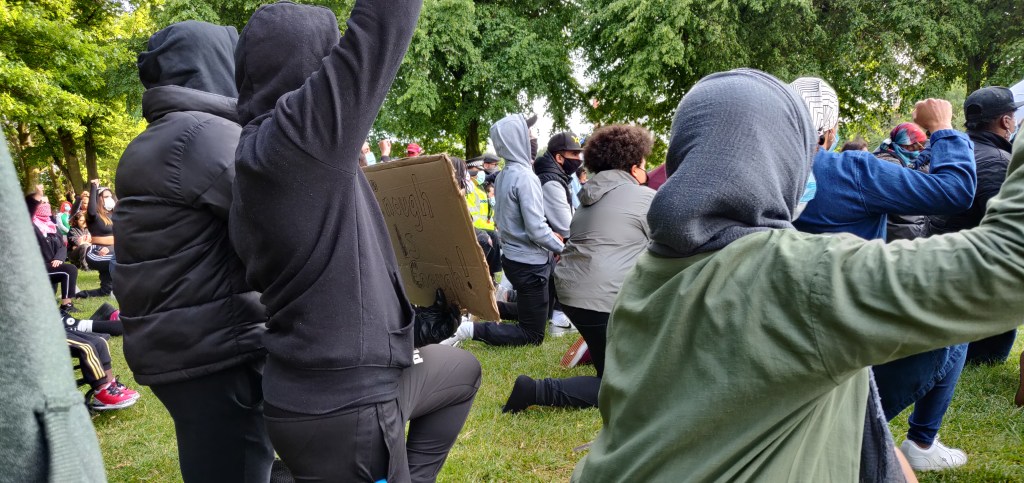
Above: a letter written and delivered as a speech at the BLM Rally on Victoria Park in Leicester
Below: content related to this letter and speech
Above: content related to Welcome To The UK 2023
Below: back to Articles
 Guerrilla Nature
Leave a comment